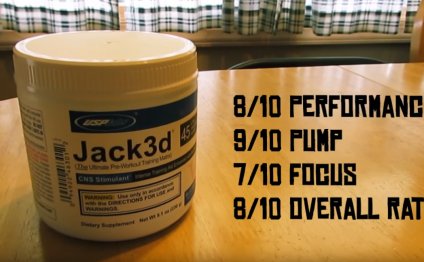
Jack3d Pre workout
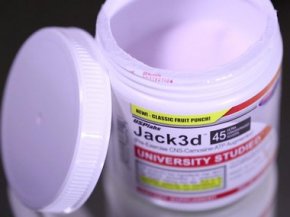 Over the past few years, a popular dietary supplement has amassed a cult-like following of fitness enthusiasts across the country. From coast to coast, you can find small white canisters filled with a pink powder tucked into gym bags, stashed in lockers and sitting in kitchen cupboards.
Devotees claim it gives them that extra edge they need to run that elusive last mile, or to lift that extra 10 pounds.
But detractors call it potentially dangerous, perhaps even deadly.
The supplement is called Jack3d (pronounced Jacked), but the ingredient that users say sets it apart from other pre-workout supplements is 1, 3 dimethylamylamine - or DMAA. The U.S. Food and Drug Administration says DMAA is illegal.
The FDA has received 86 adverse event reports believed to be linked to DMAA. Serious side effects reported to the FDA include depression, anxiety, vomiting, loss of consciousness, chest pain, and even death.
NBC News Chief Medical Correspondent Dr. Nancy Snyderman sat down with Dr. Daniel Fabricant, director of the division of dietary supplements programs at the FDA.
Fabricant's message about DMAA was clear: "It is an illegal dietary supplement."
So why is it still being sold in the US? Fabricant says, “banning it would be, you know…it’s difficult.”
The FDA has limited legal authority over supplements. In 1994, a law was passed by the U.S. government that declared dietary supplements exempt from pre-market FDA approval.
“We don't have pre-market approval…we don't evaluate [dietary supplement] products for safety or efficacy prior to them going to market, ” said Fabricant in an interview airing Friday, April 12 at 10pm/9CDT on NBC's Rock Center with Brian Williams.
So what can the agency do? On April 11, the FDA issued a consumer advisory warning against the supplement. A day later, the Council for Responsible Nutrition, the trade association representing the dietary supplement industry called on the manufacturer and consumers to heed the FDA warning.
“With this conclusion, CRN now calls on dietary supplement manufacturers to stop manufacturing these products and further advises consumers to stop using them, ” said Steve Mister, president and CEO of the Council for Responsible Nutrition in a statement released today. “The safety and well-being of consumers is always our highest priority.”
This warning is not the first time FDA raised concerns about DMAA’s safety. In 2012, the FDA sent warning letters to 11 manufacturers questioning DMAA’s safety and challenging their claims that the ingredient even qualifies as a dietary supplement. All of them voluntarily pulled their products - except for USP Labs, the makers of Jack3d.
In a written statement to NBC News, Michael Petruzzello on behalf of USP Labs maintains that, “DMAA is a safe and lawful dietary ingredient. We stand by the scientific evidence presented and believe there is no reason to withdraw it from the market.”
The company also points to “three published scientific papers [that] document that 1, 3 DMAA can be extracted from [a] geranium found in particular areas of China, ” meaning it is a natural substance, and is therefore not subject to the FDA’s drug approval process.
Dr. Pieter Cohen, a Harvard professor and member of the Cambridge Health Alliance who studies supplement safety, disagrees with USP Labs that DMAA comes from a plant.
“DMAA has nothing to do with nature … That's an absolute myth perpetuated by companies selling it, ” he says. “DMAA is a drug that manufacturers are passing off as a plant product.”
So if DMAA doesn’t come from the geranium plant, as USP Labs claims, where does it come from? Cohen says “DMAA is ... produced in a factory.”
Debates over DMAA’s origins aside, Cohen thinks the ingredient should be removed from the market for another reason: “Could it increase the risk of death? Could it lead to the death of a young healthy man? Absolutely.”
Dr. Cohen says DMAA behaves in the body like an amphetamine: “If you took a low dose of this, you might notice a slight tremor- a little more alert, awakeness, your heart beating a little faster.”
He also sees similarities between DMAA and another supplement that was famously banned years ago, Ephedra.
After the Jump, read the FDA's advisory warning and the statement from the Council for Responsible Nutrition.
“Now we're seeing situations in which people are taking this and experiencing adverse events that are completely consistent with those that we saw with Ephedra- the heart attacks, the strokes, the deaths, ” Cohen said.
In response to questions about the safety of DMAA, USP Labs had this to say: “The company is unaware of a single corroborated serious adverse event [associated with DMAA] when used in accordance with labeled directions for use, " and that there are "eight peer-review published clinical studies detailing the safety of DMAA."
DMAA has been banned in the United Kingdom, Canada, Australia and six other countries. It is also prohibited for use by athletes by many sports organization in the United States, as well as the by the International Olympic Committee. The U.S. Military now prohibits the sale of DMAA on all bases, after two soldiers who used the product died.
One of those soldiers was Private Michael Sparling. On a June morning in 2011, Sparling went for a training run on his base compound in Fort Bliss, Texas. It was comfortable 70 degree weather and the 3.5 mile circuit was nothing unusual for the young, fit soldier.
Later that morning, Michael’s mother Leanne received a phone call she’ll never forget. It was the commander of the base hospital, calling to tell her that her son was in cardiac arrest. While preparing to fly to her son’s bedside in Texas, Leanne called the hospital for an update on his condition.
"Ma'am, we've done everything we could to save him but at 11:17 this morning he passed away."
Michael Sparling was 22 years old. Grief-stricken, the Sparling family looked for answers. What could have caused their young, seemingly healthy son to die so suddenly?
During the autopsy, tests confirmed the presence of the substance DMAA in Michael Sparling’s blood. Army doctors told the Sparlings that the substance may have played a role in his death.
He had only been using the product for a month before he died.
But even tragic stories like that of Michael Sparling, and the threat of possible side effects like heart failure and cerebral hemorrhage aren’t enough to scare off many enthusiastic Jack3d users. In 2011, more than $100 million worth of DMAA-based products were sold in the United States.
INTERESTING VIDEO



INTERESTING FACTS
-
 Doctor of Philosophy, abbreviated as Ph.D., PhD, D.Phil., or DPhil (for the Latin philosophiae doctor or doctor philosophiae), in English-speaking countries, is a postgraduate academic degree awarded by universities. The academic level known as a Doctorate of...
Share this Post
Related posts
Volt Pre workout
Neon Sport Volt™ is an all-out sensory assault that is one of the strongest pre-workouts on the market. Volt™ is powered…
Read More
All natural Pre workout
Pre-Workout You put in the hard work; we’ll help you get more out of it. Pursuit Rx Pre Workout is designed with natural…
Read Morelatest post
-
 Arm Workouts Without Weights July 6, 2026
 -
 Chest shoulders Workout June 30, 2026
 -
 Kettlebell Chest Workout June 24, 2026
 -
 Things to eat after workout June 18, 2026
 -
 Female arms Workouts June 12, 2026
 -
 Tips for healthy lifestyle and Fitness June 6, 2026
 -
 Best pregnancy Workouts May 31, 2026
 -
 Muscle group Workout Plan May 25, 2026
 -
 Muscles Magazine May 19, 2026